- Free Consultation: 703-298-9562 Tap Here to Call Us




A Proffer Letter, a Lost Recording, and Kastigar


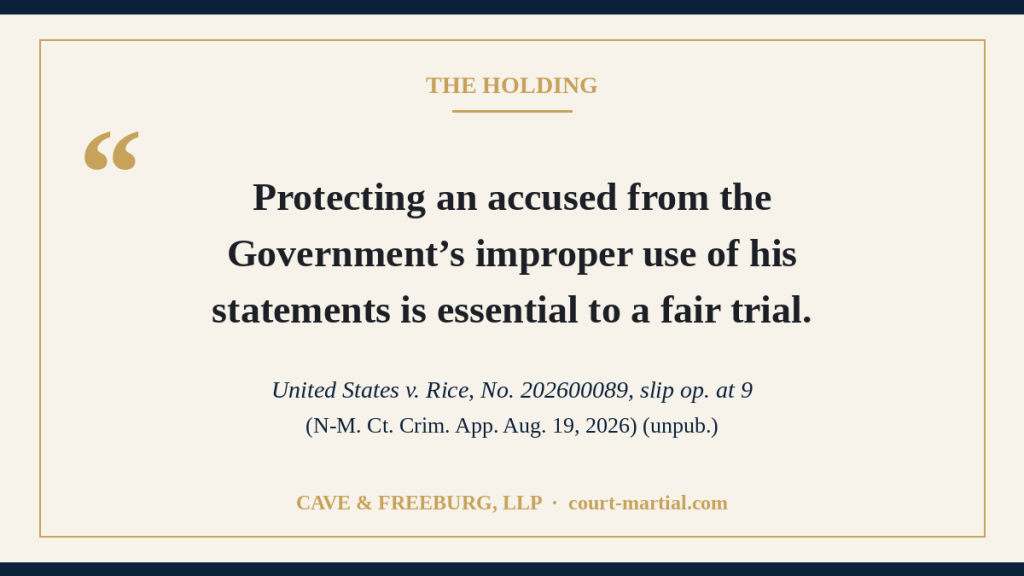
If military investigatiors want you to cooperate against someone else, the paperwork matters as much as anything you say. Rice is a Government appeal from a military judge’s abatement of trial order because the Government lost a recording of the proffer session. No recording, no trial.
At Cave & Freeburg, we defend service members in [government appeals and court-martial appeals](https://www.court-martial.com/court-martial-appeals.html) across all the services, and Rice deserves close attention from anyone negotiating cooperation with military prosecutors.
What happened in Rice
NCIS identified a sailor as one of several suspects in thefts from USS Wasp (LHD 1). His defense counsel discussed cooperation with trial counsel, and the parties negotiated a letter setting out the protections that would apply at a proffer session. The government’s first draft included a Kastigar waiver. Under it, the sailor would have agreed that the government could make derivative use of his statements and pursue investigative leads from them, and he would have given up the Kastigar hearing at which the government must prove its trial evidence is untainted. See Kastigar v. United States, 406 U.S. 441 (1972).
Defense counsel asked trial counsel to remove that waiver so the client would “have Kastigar protections.” Trial counsel agreed and confirmed by email that the client “does not waive his rights under Kastigar to challenge information if a case ends up being brought against him.” The parties signed the revised letter in February 2024, and the sailor sat for a proffer session that lasted about three hours. NCIS recorded it. By the time the government referred charges in October 2025, someone had inadvertently deleted the recording.
The military judge (MJ) denied a defense motion to dismiss but abated the proceedings until the government recovers the recording. The government appealed.
The military proffer agreement carried real protection
The government’s lead argument was simple: the proffer letter explicitly conferred no immunity, so no Kastigar problem exists. NMCCA rejected that reading, and the reasoning matters.
Only a general court-martial convening authority or designee could grant formal immunity in this case. Rule 704(c)(1), Rules for Courts-Martial (R.C.M.), Manual for Courts-Martial, (M.C.M.) United States (2024 ed.). Trial counsel had no such power, and a purported grant by someone without authority is invalid. United States v. McKeel, 63 M.J. 81, 83 (C.A.A.F. 2006). But McKeel also holds that an MJ may grant tailored relief when a suspect detrimentally relies on a promise of immunity made by someone with apparent authority. Id.
The MJ found all three McKeel ingredients here. The negotiations showed both sides understood the government could use the sailor’s information against other people but could not use it, directly or derivatively, against him. The government’s own redline, striking the waiver at defense request and confirming the change by email, supplied the promise. Trial counsel’s conduct in negotiating and signing the letter supplied the apparent authority. The sailor’s participation in the proffer session supplied the reliance. NMCCA held it did not matter that the MJ never cited McKeel by name because he applied its substance. That is a useful holding in its own right: appellate courts review what a trial judge actually analyzed, not which case names appear in the ruling.
The distinction between the two kinds of immunity did quiet work here as well. Transactional immunity bars trial altogether; testimonial immunity bars use of statements and anything derived from them but permits prosecution. R.C.M. 704(a). The MJ found the proffer letter functioned as a promise similar to testimonial immunity. The sailor could still be prosecuted. The government just had to prove its case from wholly independent sources.
The Lost Recording and R.C.M. 703
The second half of the opinion applies the lost-evidence framework of R.C.M. 703(e)(2). An accused gets relief when destroyed evidence is essential to a fair trial, no adequate substitute exists, and the accused is not at fault. See United States v. Simmermacher, 74 M.J. 196, 199 (C.A.A.F. 2015); United States v. Warda, 84 M.J. 83, 91 (C.A.A.F. 2023). The government never argued the sailor bore any fault, and it could not. NCIS barred him and his counsel from bringing electronic devices to the session, so the government held the only recording.
The government’s more interesting argument was that the recording would be inadmissible at trial, so it could not be of central importance to an issue essential to a fair trial. NMCCA disagreed. The recording was essential not as trial evidence but as the yardstick. Under Kastigar, the government bears “the heavy burden of proving that all of the evidence it proposes to use was derived from legitimate independent sources.” 406 U.S. at 461-62. And the protection sweeps beyond exhibits and testimony. It reaches non-evidentiary uses, including statements that alter investigative strategy or inform the decision to prosecute. United States v. Morrissette, 70 M.J. 431, 438 (C.A.A.F. 2012). Without knowing what the sailor said for three hours, no court can sort tainted from untainted.
That answered the government’s fallback too. It offered contemporaneous notes as an adequate substitute: two and a half pages from a Legalman and three pages from an investigator, covering a three-hour session. The MJ has broad discretion on adequate substitutes, and NMCCA saw no abuse in concluding that five and a half pages cannot police the derivative-use line for a case whose whole investigation may have been shaped by the session.
Abatement, not dismissal
The remedy holding cuts both ways, and any honest reading of Rice should say so. The defense asked for dismissal of all charges. The MJ declined, and NMCCA endorsed the calibration: dismissal becomes appropriate only after a Kastigar hearing determines the government actually made improper use of protected information. When the lost recording makes the hearing itself impossible, abatement is the tailored answer. The government keeps the theoretical ability to revive the case by recovering the recording, and a footnote confirms NMCCA’s jurisdiction precisely because that prospect is so remote that the abatement is the functional equivalent of terminating the proceedings. See United States v. Badders, 82 M.J. 299, 304 (C.A.A.F. 2022).
The government also retains arguments for the long game. Rice is unpublished and binds no one, though NMCCA Rule of Appellate Procedure 30.2 permits citation as persuasive authority. And nothing in the opinion prevents the government from arguing, in the next case, that a proffer letter with cleaner language, an express no-immunity clause, and an intact record confers nothing enforceable.
What Rice Means for Servicemembers
First, never walk into an NCIS, CID, OSI, or CGIS interview, cooperative or otherwise, without counsel. Your [rights during a UCMJ investigation](https://www.court-martial.com/practice-areas/under-investigation/ucmj-investigations/) exist before anyone reads you a charge sheet, and investigators are trained to get statements. We have written before about [how NCIS approaches interrogations](https://www.court-martial-ucmj.com/15206-2/).
Second, if cooperation is on the table, the proffer letter is a contract and every word is a term. Rice turned on a deletion. Defense counsel struck the Kastigar waiver, and the government’s written agreement to strike it defined the promise the courts later enforced. Save the emails. The negotiation history proved the meaning of the letter.
Third, when the government appeals a ruling in your favor, the playing field tilts your way for once. On an Article 62 appeal the court views the evidence in the light most favorable to the party that prevailed below and stays bound by the MJ’s fact-finding unless it is clearly erroneous. Defending those appeals is a distinct skill, and we have won them.
If you face a military justice investigation, a government appeal, or a court-martial appeal, call Cave & Freeburg, LLP, at (703) 298-9562 or (917) 701-8961.